English| EUR
Suggested for you
More currencies
Choose a language
Two of Greece's defining sites sit on the same northwestern axis out of Athens, yet many visitors plan them as if they were unrelated. This how to get from athens to delphi and meteora guide sets out the geography first, then the timing that follows from it. The aim is a plan that survives contact with a real morning.
Quick answer
Both sites lie northwest of Athens on a single overland corridor, with Delphi roughly midway and Meteora near Kalambaka at Meteora, Kalambaka 422 00, Greece. Monasteries open 09:00–17:00, and the recommended arrival window is 09:00–10:30 to precede the later bus tour crowds. The main caveat: each monastery closes on a different weekday, so sequencing matters more than speed.
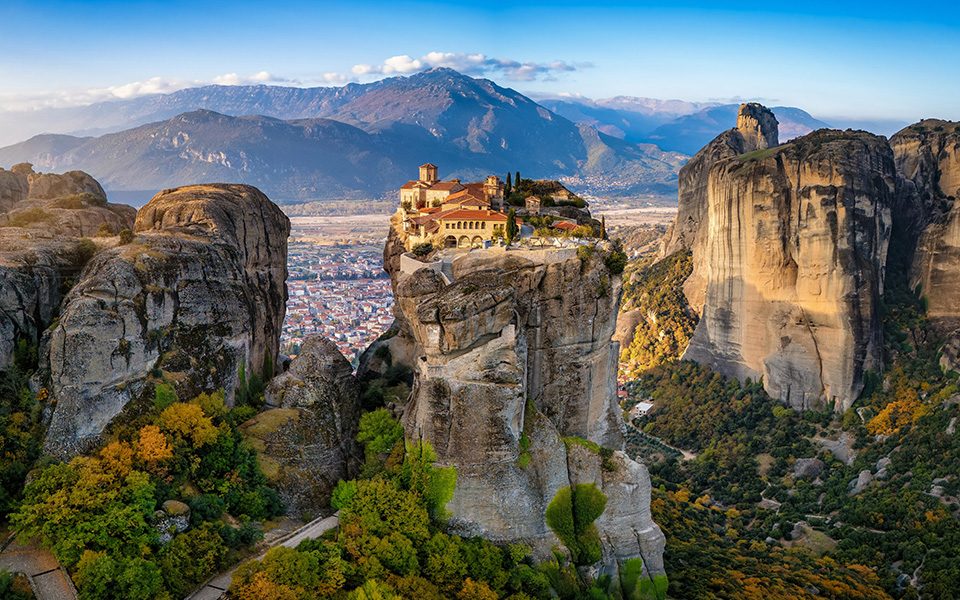
Delphi and Meteora were sacred long before they became destinations, and both owe that status to vertical rock. The ancients placed the omphalos at Delphi on the slopes of Mount Parnassus, marking it the navel of the world; some fifteen centuries later, hermits hauled themselves up sandstone pillars near Kalambaka in nets and baskets to build monasteries where no army could follow. The two sites face each other across the Pindus foothills, separated by mountain road rather than distance on a map. Understanding how to get from athens to delphi and meteora begins with accepting that the corridor is not a straight line. The route climbs out of the Attica basin, crosses the plain of Boeotia past Thebes and Livadeia, and then ascends through olive terraces to the Sacred Way, the Temple of Apollo and the Delphi Archaeological Museum. From there the road continues north through Amfissa and Lamia toward Trikala and the Thessalian plain, where the Meteora pillars appear abruptly above the Pineios valley. Travellers who search for a Delphi and Meteora tour from athens, or in Greek for a Δελφοί και Μετέωρα εκδρομή, are usually weighing whether that arc compresses into one day or opens into two. Elevation and switchbacks, not kilometres, answer the question. The second variable is physical. Reaching the monastery courtyards means stairs cut into rock — around 300 steps at the most-visited houses, plus enclosed passages and exposed terraces. Shoulders and knees must be covered; wraps are lent at the gates. Cash matters at each entrance, and mobile signal thins between valleys, so screenshots outperform live maps. What to do with all this is straightforward. Treat Delphi as a morning or late-afternoon site and Meteora as a first-light one, because the monasteries share a 09:00–17:00 rhythm and empty out well before dusk. Decide the direction of travel before booking anything: whether Athens–Delphi–Kalambaka or the reverse, the sequence dictates where the overnight falls. Anyone still comparing options for how to get from athens to delphi and meteora should settle the route order first — the rest of the itinerary, from Kastraki guesthouses to Arachova stops on Greek landmarks, arranges itself around that single decision. Detailed schedules, fares and timing tables follow in the sections below.
“Elevation and switchbacks, not kilometres, decide whether Delphi and Meteora fit into one day or two.”
Delphi and Meteora are located in central and northern Greece, respectively, and are best reached by a combination of public transport or rental car from Athens. Travelers typically head to Delphi first, followed by the journey north to Kalambaka, the gateway to Meteora.
KTEL bus from Athens Liosion Station to Delphi
Hellenic Train from Athens to Kalambaka (often with a transfer at Paleofarsalos)
National Road E75 to E65 (via Lamia) to Kalambaka
To avoid peak bus tour crowds arriving later in the morning, plan your arrival to Meteora between 09:00–10:30.
This three-day flow suits independent travellers who want time at both sites without doubling back to Athens each night, covering roughly 72 hours from departure to return. It works equally well as a self-drive plan or as the backbone of a guided multi-day trip.
Leave Athens early and head northwest via Livadeia and Arachova, allowing a stop in Arachova for coffee before the final climb to Delphi.
Walk the Sacred Way past the Athenian Treasury to the Temple of Apollo, the theatre and the stadium, then the Delphi Archaeological Museum for the Charioteer. Budget three hours and wear grip-soled shoes for the loose marble.
Stay in Delphi town or Arachova. A short walk to the Castalian Spring and the Tholos at Athena Pronaia fills the last hour of daylight.
Continue north through Lamia and Trikala, arriving in Kalambaka by early afternoon. Check in first so you are not carrying luggage on the rock paths.
Follow the monastery ring road for a first look at Great Meteoron, Varlaam and Roussanou, then take in sunset from the Psaropetra viewpoint.
Arrive in the 09:00–10:30 window to avoid peak bus tour crowds arriving later in the morning. Expect around 300 steps of access, and cover shoulders and knees at every gate.
Leave Kalambaka after lunch for the drive back, or continue to Thessaloniki if you are heading further north.
The period between April and May or September and October offers the most favorable balance of moderate temperatures and manageable visitor numbers. When visiting Meteora, arriving early is essential to navigate the 300 steps and monastery grounds before the primary wave of bus tours.
Mild, 15°C–22°C
Spring offers blooming landscapes and temperate conditions for hiking between sites.
Hot, 28°C–35°C
Summer months experience significant heat and peak tourist traffic at both Delphi and Meteora.
Mild, 16°C–24°C
Autumn provides clear skies and cooler air, ideal for exploring archaeological sites.
—
The best arrival window is 09:00–10:30 to avoid peak bus tour crowds arriving later in the morning.
Verdict: Plan your travel for April or October and aim to reach the Meteora gates between 09:00–10:30 on weekdays.
Monastery entrance fees in Meteora are independent of travel arrangements from Athens and are payable directly at each site. All visitors should prepare for these costs separately from any transportation or tour expenses.
Verdict: Each adult pays 5 EUR per monastery, and total costs depend solely on how many individual monasteries you choose to enter.
The monasteries in Meteora maintain consistent operating hours throughout the week to accommodate visitors. Planning your arrival within the recommended window helps avoid peak congestion.
Everything you need to know about how to get from athens to delphi and meteora
Travelers typically combine private transfers, rental cars, or organized coach trips to reach these landmarks efficiently. Planning ahead ensures you have enough time to explore the archaeological site of Delphi and the stone forests of Meteora. Most visitors find that booking a multi-day excursion is the most stress-free method for those researching how to get from athens to delphi and meteora.
A two-day or three-day itinerary is recommended to adequately cover both locations without feeling rushed. This allows time for the drive through the Pindus Mountains and sufficient duration to explore the UNESCO-protected monasteries.
While a train connects Athens to Kalambaka, navigating the route independently requires multiple transfers if you intend to see the Oracle of Delphi first. Many visitors prefer direct transport to avoid the complexities often associated with local transit schedules.
Traveling with children requires careful pacing, especially when planning how to get from athens to delphi and meteora given the long driving distances involved. Ensure your schedule includes frequent breaks and considers that some monastery access involves climbing 300 steps.
The monasteries are open daily from 09:00–17:00. Arriving between 09:00–10:30 is recommended to avoid the heaviest concentration of bus tour visitors.
The entrance fee is 5 EUR per person, per monastery, payable in cash at each individual gate.
3-Day Delphi and Meteora Tours
Read more Tickets & toursPrivate Delphi and Meteora Tours
Read more GuideDistance from Athens to Delphi
Read more GuideTrain Travel to Meteora
Read more Tickets & toursDelphi and Meteora 2-Day Tour
Read more Tickets & toursDelphi and Meteora Day Trip
Read more